research date: October 2026
Executive Briefing
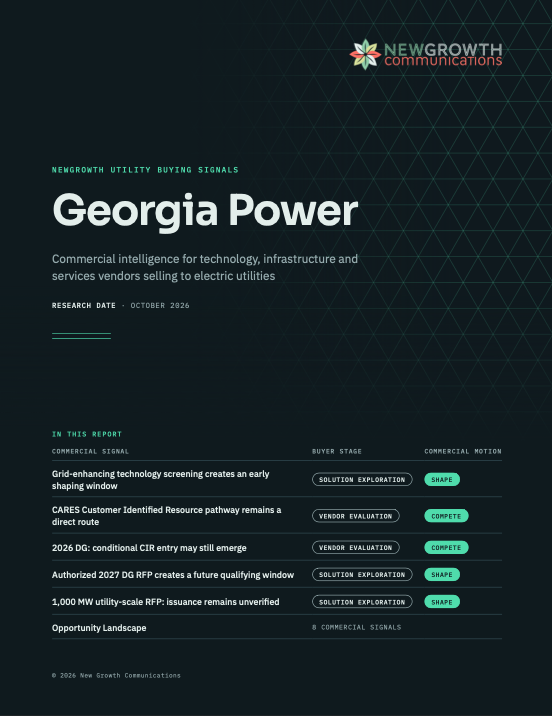
The strongest Georgia Power opportunities for technology and infrastructure vendors are currently upstream of procurement. A formal requirement to evaluate grid-enhancing technologies (GETs) on major transmission projects creates a credible SHAPE-stage opening for vendors that can support technical and economic evaluation. No standalone GET procurement is visible, and previously announced SmartValve work should not be treated as available to rebid.
The clearest direct participation route is the Clean and Renewable Energy Subscription Customer Identified Resource (CARES CIR) pathway. Georgia Power’s program materials described enrollment as open at the research date, allowing eligible customers and renewable developers to identify projects that may lead to developer power purchase agreements with Georgia Power. This is a noncompetitive project-development route, not a general equipment, software or services solicitation.
Two distributed-generation (DG) procurements require different treatment. The original 2026 DG bid window closed June 29, 2026, but approved terms contemplate a conditional Extended RFP Period that could accept new CIR proposals if unmet subscription demand remains. Activation and current dates have not been verified. Separately, a 2027 DG RFP is authorized but not yet verified as issued. An authorized 1,000 MW utility-scale renewable RFP is also still in the SHAPE stage: its expected Q3 2026 launch passed without verified issuance or a replacement timetable.
Several large programs remain commercially significant without a current outside-vendor opening. These include the 2032–2033 All-Source RFP, ongoing distributed energy resource management system (DERMS) implementation and the 500 MW energy-storage procurement. Continuing evaluation or implementation does not establish new sellable scope.
Main takeaway: Georgia Power presents several meaningful opportunities, but the right action ranges from direct project participation to technical shaping and monitoring. Vendors should distinguish verified access from conditional future entry and continuing utility activity.
Top Commercial Signals
-
Stage: Solution Exploration
Commercial motion: SHAPE
Who should care
Dynamic line rating, transmission monitoring, advanced power-flow-control, sensing, modeling, analytics and specialist transmission-engineering firms.What’s happening
Georgia Power is required to evaluate grid-enhancing technologies as alternatives for major transmission projects and report evaluation assumptions and outcomes in its 2028 Integrated Resource Plan (IRP). The scope includes technologies such as dynamic line rating, advanced power-flow control and advanced conductors. Georgia Power has separately announced SmartValve deployments with Smart Wires, but that existing work is not evidence of an open procurement. The commercial value of this signal is the repeatable evaluation requirement, which creates a defined opportunity to influence future project assessments before requirements harden.Commercial opening
The current opening is account development and shaping only. No standalone GET procurement or unawarded package is verified. Existing SmartValve work has a named provider and should not be treated as available to rebid. -
Stage: Vendor Evaluation
Commercial motion: COMPETE
Who should care
Renewable project developers, specialized interconnection engineers, storage and system-integration firms, and project feasibility and design advisors.What’s happening
Georgia Power’s CARES Customer Identified Resource pathway allows eligible commercial and industrial customers to identify renewable projects and developers to propose them. Georgia Power then contracts with qualifying developers through long-term power purchase agreements (PPAs), while customers participate through subscription agreements. Program materials described CIR enrollment as open at the research date. That makes this one of the clearest current commercial routes in the report, but it is primarily a project-development pathway rather than an RFP for equipment, software, DERMS or general grid services.Commercial opening
A direct utility sale through a noncompetitive route is visible for eligible developers using the CIR mechanism. For equipment and technology suppliers, an indirect opportunity becomes credible only when tied to a named eligible project or developer. -
Stage: Vendor Evaluation
Commercial motion: COMPETE
Who should care
Distributed solar and storage developers, interconnection and power-systems engineers, inverter and storage-controls vendors, and DER integration specialists.What’s happening
Georgia Power’s 2026 distributed-generation RFP seeks approximately 229.7 MW, including roughly 50 MW of newly authorized capacity and approximately 179.7 MW carried forward from prior procurement. The original bid deadline was June 29, 2026, and late initial-round bids are prohibited. Existing participants can continue through evaluation and qualifying submission refresh. Separately, the approved RFP provides for a conditional Extended RFP Period that may accept new Customer Identified Resource proposals if CARES DG subscription demand remains unmet. Activation and actual dates remain unverified.Commercial opening
The current opening is Unknown for new entrants. The initial prime-bid window is closed. A new CIR entry route exists in the approved rules only conditionally and cannot be described as open unless activation and current submission dates are confirmed. -
Stage: Solution Exploration
Commercial motion: SHAPE
Who should care
Distributed solar and storage developers, grid-interconnection engineering firms, and DER integration and controls vendors supporting qualified developers.What’s happening
The Georgia Public Service Commission authorized a separate 2027 distributed-generation RFP targeting 50 MW of new resources. It is distinct from the 2026 solicitation and is expected to support renewable resources for Georgia Power’s CARES DG subscription program. As of the research cutoff, no final 2027 RFP package, bidder-registration rules or proposal deadline had been verified. The authorization nevertheless creates a defined future procurement trajectory and gives eligible developers and supporting technology firms time to prepare before formal evaluation begins.Commercial opening
The current opening is account development and shaping only. No issued 2027 solicitation or direct-prime bid window is verified. The anticipated route is through the future Georgia Power DG RFP once its documents and eligibility rules are published. -
Stage: Solution Exploration
Commercial motion: SHAPE
Who should care
Utility-scale renewable developers, project engineering and interconnection firms, grid-modeling specialists, storage integrators, controls vendors and project partners.What’s happening
Georgia Power has regulatory authorization to procure up to 1,000 MW of new utility-scale renewable resources through an enhanced competitive RFP process, separate from additional customer-driven procurement authority. The company had expected to issue the 2026 Utility Scale RFP in Q3 2026. That target has passed. As of October 15, no distinct issued solicitation, current bidder deadline, dedicated independent-evaluator portal, revised timetable, cancellation or superseding process had been verified. The procurement remains specific and authorized, but it should not be described as currently open.Commercial opening
The current opening is account development and shaping only. Qualified developers are expected to be the eventual direct bidders, while equipment, engineering, storage, controls and interconnection vendors would generally pursue developer or project-partner relationships.
Also on our radar
Eight additional areas merit monitoring for future sourcing, expansion, rebid, replacement or partnership opportunities.
- 2032–2033 All-Source RFP
- DERMS implementation
- Demand-side management/demand response (DSM/DR) potential study
- 500 MW energy-storage RFP
- Customer DER pilots
- Advanced metering infrastructure (AMI) meter replacement
- 2026–2028 DSM portfolio
- Hydro modernization studies
The full report includes NewGrowth's assessment of the current commercial opening for each area and the specific events that would make it more actionable.
Related buying cases
These historical examples illustrate utility purchasing processes, not currently open solicitations or unawarded supplier work.
Georgia Power — 2029–2031 All-Source Capacity RFP — An earlier, separate procurement screened resource bids against economics and transmission requirements and led to regulatory certification of 18 competitively selected resources totaling 7,999 nominal MW. Read the Buying Case →
Naperville — SCADA / OMS / DERMS Modernization — In a similar 2025 municipal-utility procurement, three proposals were scored, two finalists completed interviews and demonstrations, and City Council approved a six-year award to Survalent. Read the Buying Case →
How to read Utility Buying Signals
NewGrowth Utility Buying Signals are based on public-source research, with priority given to utility filings, regulatory proceedings, procurement materials, planning documents and other primary sources.
We distinguish between Buying Signals, where a specific commercial opening or credible vendor action is visible, and Commercial Landscape Signals, which provide useful context but do not yet establish an actionable opportunity.
Public sourcing information can be incomplete, particularly for private or invitation-only procurement. The absence of a public signal does not mean that no utility spending exists.
Commercial motions
INFLUENCE: Frame the problem and desired outcomes.
SHAPE: Help define requirements, architecture and sourcing assumptions before they harden.
COMPETE: Respond to formal evaluation and procurement.
CLOSE: Reduce risk and support final selection.
DELIVER: Turn implementation into successful proof.
EXPAND: Grow into additional scope, sites or phases.
From the NewGrowth Engine
Utility buying does not begin with the RFP. NewGrowth helps utility vendors connect market evidence to the right positioning, content and commercial action across the buying journey.
The commercial motions framework above comes from the NewGrowth Engine for Utility Vendors. Learn more about it here.
For help turning utility-market intelligence into sharper positioning, content and pursuit strategy, contact:
Bart King
Founder and Principal
Bart.King@4newgrowth.com
706-340-3140
Disclaimer: This report is provided for informational and commercial-planning purposes only. It is based on publicly available information believed to be reliable at the time of research, but New Growth Communications does not guarantee its completeness or continued accuracy. Procurement status, eligibility, timing and requirements may change. Vendors should verify current information directly with the utility or relevant procurement authority before acting.